How to be a good humanitarian donor?
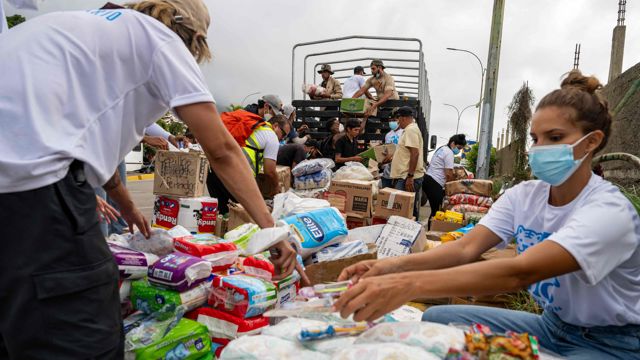
Volunteers distribute food and emergency supplies in Caraballeda in La Guaira state, Venezuela, following the earthquakes on 24 June 2026.
Being a good humanitarian donor is not only about how much money is provided. It is also about how quickly the money reaches those who need it, how flexibly it can be used, and whether it reaches the people and places where the needs are greatest.
When a crisis occurs, the situation can change rapidly. A conflict may escalate, a flood may affect new areas, or an epidemic may break out. Assistance must therefore be able to adapt.
Humanitarian organisations need not only funding, but also the flexibility and space to act.
Assistance should be guided by needs and principles
A fundamental principle of humanitarian assistance is that help should go to those who need it most. Who they are, where they live or how much attention the crisis receives should not determine whether they receive assistance.
Humanitarian assistance should be impartial, neutral and independent. This means that political considerations should not determine who receives assistance.
For a donor, this means that it is not always best to decide in advance exactly what every pound or krone should be spent on. Funding must be able to follow developments in the crisis.
Flexible funding leads to better assistance
Flexible funding gives humanitarian organisations greater scope to use resources where the needs are greatest.
The major advantage is that the funds are already available when a crisis occurs. This means that relief efforts can begin immediately, without waiting for new decisions or funding rounds. In the event of an earthquake, flood or sudden escalation of conflict, this can be critical.
Flexibility does not mean less control. Organisations must still document how the funds are used and what results they achieve. But they have greater scope to act quickly and appropriately.
Flexible funding can also make it easier to prioritise crises that receive little media attention.
When time is critical, funding must be ready
In the first hours and days after a crisis, a rapid response can save lives. Funding must therefore already be in place.
Norway therefore supports, among other things, global funds and funding mechanisms such as:
- the UN Central Emergency Response Fund (CERF)
- the International Red Cross and Red Crescent Movement’s Disaster Response Emergency Fund (DREF)
In addition, Norad can use the humanitarian reserve to address urgent needs that arise throughout the year and are not covered by the regular allocation process.
Norway’s strategic humanitarian partners also have access to flexible funding that can be released when new crises arise or existing crises deteriorate.
This gives organisations the ability to respond quickly and to prioritise resources themselves based on needs in different contexts. In this way, flexible funding through these partnerships functions as a form of humanitarian reserve.
These arrangements make it possible to mobilise funding quickly when a crisis occurs or worsens.
Predictable funding
Flexibility is important, but it is not enough. Humanitarian organisations also need stable and predictable funding to plan, retain expertise and build capacity over time.
Core funding and other forms of flexible financing give organisations the opportunity to prioritise and allocate resources themselves according to where needs are greatest. This can also provide scope for preparedness, capacity development and work on cross-cutting challenges that do not always fit within a specific project.
Good humanitarian donorship is therefore about combining flexibility, rapid response and predictable funding, while ensuring that humanitarian actors have sufficient scope to use resources where needs are greatest.
Local actors must be strengthened
Those closest to a crisis often know best what is needed. Humanitarian response should therefore be based on the needs, priorities and capacities of the people and communities affected.
International organisations are only one part of the humanitarian response. Families, communities, local and national organisations, authorities and other networks play a crucial role before, during and after a crisis.
Good humanitarian donorship is therefore not only about providing more funding to local organisations. It is also about giving them greater influence over decisions, and ensuring that international efforts support local priorities and solutions.
Trust and accountability must go hand in hand
Humanitarian organisations are often closer to a crisis than donors are. They are usually in the best position to understand what is happening locally and what should be prioritised.
This requires trust. At the same time, there must be requirements for financial management, documentation, results and accountability.
Good donorship is therefore not about choosing between trust and control. It is about having both.
Norway’s approach
Norway is a major humanitarian donor and supports, among others, the UN, the International Red Cross and Red Crescent Movement and other humanitarian organisations.
Through long-term partnerships and close dialogue, Norway gains greater insight into the organisations’ work and results. This provides a sound basis for trust – and for providing flexibility when needs change.
At the same time, Norway follows up on its partnerships through, among other things, board participation and dialogue, and helps set the direction for the work.
Norway emphasises that humanitarian funding should be rapid, flexible and predictable. Norway therefore supports both multi-year agreements and funds that can be used when new crises arise or existing crises deteriorate.
Norway also contributes to strengthening local and national capacity to respond to humanitarian crises.
What characterises a good humanitarian donor?
A good humanitarian donor ensures that:
- Assistance follows needs and humanitarian principles
- Funding is flexible and predictable
- Money can be mobilised quickly
- Organisations have stable and long-term funding
- Local and national capacity is strengthened
- Trust and accountability go hand in hand
Norway aims to be a good humanitarian donor.
These principles are reflected, among other places, in Good Humanitarian Donorship and in the Strategy for Norwegian Humanitarian Policy 2024–2029.