What does Norwegian support to Ukraine go towards?
Through the Nansen Support Programme for Ukraine, Norway provides a wide range of civilian and humanitarian support. See an overview of the support by year from 2022.
Through the Nansen Programme for Ukraine, Norway contributes to protecting the civilian population, maintaining essential public services and laying the foundations for reconstruction and economic development.
The programme is Norway’s largest aid initiative ever. Norway is a long-term partner for Ukraine and has committed a total of NOK 275 billion in military and civilian support through the Nansen Programme up to 2030.
In 2026, NOK 15 billion has been allocated to civilian support.
In 2025, Norad managed NOK 11.5 billion in civilian funding through the programme, and since 2022 a total of NOK 52.2 billion has been disbursed in civilian assistance up to and including 2026. In 2025, support was distributed among 59 partners through 79 agreements, mainly via the UN, development banks, international organisations and Ukrainian civil society actors.
Ukraine’s needs and priorities form the basis for Norwegian support. Norway coordinates closely with the Ukrainian authorities, international financial institutions and other donors, including through the Ukraine Donor Platform, to ensure the effective use of funds and support Ukraine’s reforms and European integration.
Read this article in Ukrainian: Натисніть тут для версії українською мовою
Areas prioritised by Norwegian aid:
- Reconstruction, development and operational support
- Energy sector
- Humanitarian aid
- Human rights, governance and civil society
- Private sector and business development
- Cross-cutting considerations and risk management
- Support for Moldova
The Nansen Support Programme for Ukraine and region from 2022 til 2026:
| 2022 | 2023 | 2024 | 2025 |
2026 (so far) |
Total 2022-2026 (so far) |
|
| Total year | NOK 6,2 billion | NOK 8,7 billion | NOK 9,95 billion | NOK 12,44 billion | NOK 14,91 billion | NOK 52,2 billion |
| Humanitarian aid | NOK 2,6 billion | NOK 2,8 billion | NOK 3,04 billion | NOK 3 billion | NOK 3,5 billion | NOK 14,9 billion |
| Energy sector | NOK 2,1 billion | NOK 1,9 billion | NOK 2,25 billion | NOK 5,5 billion | NOK 4,8 billion | NOK 16,5 billion |
| Budget support | NOK 1,35 billion | NOK 3,1 billion | NOK 3,6 billion | NOK 2,8 billion | NOK 4 billion | NOK 14,9 billion |
| Governance, democracy and reforms | NOK 11,2 million | NOK 77,9 million | NOK 181 million | NOK 436 million | NOK 925 million | NOK 1,6 billion |
| Private sector support | NOK 314 million | NOK 503 million | NOK 341 million | NOK 800 million | NOK 2 billion | |
| Support to Moldova (non-humanitarian aid) | NOK 150 million | NOK 520 million | NOK 350 million | NOK 350 million | NOK 350 million | NOK 1,7 billion |
| Ukraine (and region) | NOK 5,9 billion | NOK 7,9 billion | NOK 9,4 billion | NOK 12 billion | NOK 14,5 billion | NOK 49,8 billion |
| Moldova total | NOK 287 million | NOK 795 million | NOK 549 million | NOK 500 million | NOK 402 million | NOK 2,5 billion |
The figures for 2026 are preliminary and will be updated continuously.
Reconstruction, development and operational support
The war has caused enormous economic and infrastructural damage in Ukraine. A central part of Norway’s support is therefore directed towards operational and budget support, repairs to damaged infrastructure and measures contributing to early reconstruction and economic stability. This helps ensure that the population continues to have access to essential services through the state’s own functioning systems.
A large share of the support is channelled through international financial institutions with established systems for financial management, oversight and coordination.
Results of operational support:
The World Bank’s Ukraine Relief, Recovery, Reconstruction and Reform Trust Fund (URTF) is one of the most important instruments.
Norway is the fund’s largest contributor and has provided more than NOK 11 billion. The fund totals USD 2.8 billion, and Norway is the largest among 19 donors.
Among other things, the support finances salaries for public employees, social benefits, repairs to the energy grid, reconstruction of roads and railways, agriculture, healthcare, education and reforms to improve framework conditions for the private sector.
In January 2026, Norway disbursed NOK 2 billion to help cover Ukraine’s need for bridge financing through the state budget until new EU funding is in place later this year.
The support helps maintain basic societal functions and ensure economic and institutional stability throughout the war. URTF programmes have collectively reached more than 20 million people across sectors and delivered 48 million individual services.
Energy sector
Russia’s targeted attacks on energy infrastructure have been among the war’s most serious consequences for civilians. Destroyed power plants, substations and district heating facilities have led to widespread power outages and weakened energy security.
Energy is therefore one of the largest focus areas within Norway’s civilian support. Norway supports the energy sector through a combination of emergency measures, including gas purchases, electricity grids, and district heating, as well as longer-term investments in energy efficiency and green technology.
The European Bank for Reconstruction and Development (EBRD) is a key partner in ensuring energy security and functioning infrastructure supplying electricity and heating to end users. Through the EBRD, Norway has particularly supported the state-owned companies Ukrenergo (electricity) and Naftogaz (gas).
The EBRD has a long-standing partnership with these companies and has contributed to reforms in corporate governance and measures reducing corruption risks.
Norway has also entered into cooperation with the EU’s Ukraine Investment Framework on support to the energy sector, which in 2025 was used to support gas procurement needs.
In addition, the United Nations Development Programme (UNDP) is an important actor in accelerating the development of more decentralised gas-powered electricity supply.
Norway also supports the Energy Community in procuring critical equipment for rebuilding damaged energy infrastructure.
Some support is also channelled through the World Bank and operational support programmes to energy projects managed by the World Bank.
Results of Norwegian energy support (2022–2026)
- As of March 2026, Norway has contributed NOK 7.1 billion towards gas procurement through the EBRD and the EU’s Ukraine Investment Framework, crucial for electricity generation, heating and cooking. Norwegian contributions through the EBRD accounted in 2025 for approximately 7 per cent of household gas consumption and 13 per cent of Ukraine’s total gas import requirements.
- In total, Norway has supported the energy sector with NOK 14.7 billion since 2022, channelled through the World Bank, Energy Community, UNDP, EBRD and the Nordic Green Bank (NEFCO). The support has gone towards rebuilding the energy sector, gas procurement and implementing measures to improve energy efficiency. A further NOK 2.8 billion is planned for 2026.
- Support through URTF and Energy Community has contributed to repairing and restoring electricity and district heating systems, benefiting an estimated 5 million customers, while district heating measures alone reached up to 300,000 people.
- At the same time, a new multi-year agreement with UNDP, together with other energy measures, is providing new or more reliable electricity supply to around 900,000 people, with the potential to reach an additional approximately 1 million people through ongoing initiatives.
Humanitarian aid
The war has created one of Europe’s largest humanitarian crises. Millions of people are internally displaced, and many live in frontline areas where access to basic services is limited.
In 2025, Norway channelled NOK 3 billion in humanitarian assistance to Ukraine and Moldova through agreements with the UN, the Red Cross Movement, and Norwegian and international humanitarian organisations.
Norwegian humanitarian aid protects civilians, including internally displaced persons, people living near the front line and those returning to liberated areas. Efforts include:
- food assistance and cash support to households
- shelter and housing repairs
- water and sanitation
- healthcare services, including mental health
- sexual and reproductive health
- protection against sexual and gender-based violence
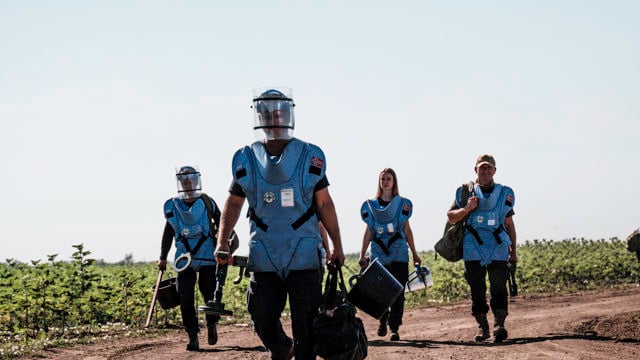
- demining and safe access to agricultural land
- access to education and safe schools
Cash assistance is an important tool that gives families flexibility to meet urgent needs while also helping sustain local markets.
Results of Norwegian humanitarian support (2023–2025)
- 5,100,000 people have received food or cash assistance.
- 5,800,000 people, particularly in frontline areas, have gained access to clean water and sanitation services.
- 4,300,000 people have received medical assistance.
- 3,144,670 m² has been cleared of mines by Norwegian People’s Aid and the HALO Trust.
- Through the humanitarian portfolio, Norway contributed in 2025 to approximately five million people receiving at least one form of humanitarian assistance.
Demining is a key area that enables local communities to move safely and bring agricultural land back into use.
Strengthening the local humanitarian response
Ukraine has a strong civil society and relatively well-functioning public institutions, even during the war. This makes possible a more locally rooted humanitarian response than in many other crises.
Norwegian support is provided through the United Nations, including the Ukraine Humanitarian Fund (UHF), the Red Cross Movement, as well as Norwegian and other international organisations.
Norway works actively to ensure that a larger share of support reaches Ukrainian organisations and local actors, which often have the best access to frontline areas and particularly vulnerable groups.
The UHF is a central mechanism for rapid and flexible response. The scale of the fund and its ability to mobilise quickly make it possible to reach frontline and particularly exposed areas. In 2025, nearly 60 per cent of the funding went directly to local actors, strengthening local capacity, operational access and the effectiveness of aid. Norway was among the largest contributors to the fund.
In addition, medical evacuation of patients (MEDEVAC) and material assistance through the EU Civil Protection Mechanism (UCPM) are important complementary measures.
Human rights, governance, and civil society
The war poses a serious challenge to democratic institutions and the rule of law. At the same time, reforms and stronger institutions are essential for Ukraine’s long-term stability and ambitions for EU membership.
Through its civil society support scheme, Norway finances initiatives that strengthen democracy, the rule of law, human rights and anti-corruption efforts through multilateral actors and Ukrainian civil society. These efforts contribute to reforms in decentralisation, transparency, accountability and integrity in public administration. Norway also supports efforts to hold Russia accountable for its warfare through the identification, documentation, investigation and prosecution of possible war crimes and human rights violations, as well as work to account for the large number of missing persons.
Women remain underrepresented in public institutions and decision-making processes in Ukraine. Norway supports measures that strengthen the rights, participation and position of girls and women in society. Efforts also include strengthening the capacity to safeguard the rights of other marginalised and particularly vulnerable groups, including people with war injuries, psychological trauma and disabilities, internally displaced persons, children and the LGBT+ community.
Results
- More than 300 civil society organisations received support in 2025 for work related to democratic participation, human rights, anti-corruption, investigative journalism and women’s participation in reconstruction.
- Support to independent media has had particularly broad reach, including in frontline areas, and has helped counter disinformation in a context of high democratic risk.
- Civil society monitoring of major public and international financial transfers has contributed to reducing corruption risks and strengthening democratic oversight.
- Institutional cooperation between Statistics Norway and Ukraine’s State Statistics Service helped maintain critical national statistical production during the war, including securing data following a major cyberattack and strengthening gender-disaggregated statistics.
Private sector and business development
Through the Nansen Programme, Norad facilitates increased investment and business development in Ukraine by reducing risks for companies operating in a war-affected market. Support is provided, among other things, through Norad’s business support scheme, which has so far supported pre-projects within renewable energy and critical services such as pharmaceutical supply. The aim is to mobilise private capital, strengthen energy security, create jobs and contribute to the green and sustainable reconstruction of Ukraine.
Norad also supports business development in Ukraine through measures that both stimulate investment and strengthen competitiveness in the private sector. In a high-risk market, Norad contributes to schemes that reduce uncertainty, including war-risk insurance and financial instruments. This makes it possible to mobilise more capital for critical sectors and reconstruction, while strengthening the insurance and financial markets so that local actors can provide better services to businesses.
A particularly important priority is strengthening small and medium-sized enterprises (SMEs), which form the backbone of the Ukrainian economy. Support is aimed at maintaining activity, safeguarding jobs and helping businesses prepare for deeper integration with the EU. This includes measures promoting restructuring, increased productivity and improved quality so that Ukrainian SMEs can meet the requirements of the European market and strengthen their competitiveness.
In addition, Norad has supported measures to ensure stable energy access for businesses, including through local energy production and storage. This reduces vulnerability to power outages and provides businesses with better conditions for operations, adaptation and long-term growth.
Cross-cutting considerations and risk management
Human rights, women’s rights and gender equality, anti-corruption, climate and the environment are cross-cutting priorities in all Norwegian assistance to Ukraine.
Providing aid in a country at war involves high risk, which makes robust risk assessments and follow-up essential. Efforts must reduce vulnerabilities rather than reinforce them.
Effective anti-corruption efforts are a fundamental prerequisite for sustainable results and Ukraine’s European integration. This work is strengthened through cooperation with organisations including the OECD, UNODC, the World Bank and civil society organisations and media engaged in investigative journalism.
Support for Moldova
The ripple effects of the war continue to affect neighbouring countries. As of November 2025, Moldova had received nearly 137,000 Ukrainian refugees. Half of them are children.
In recent years, Moldova has reduced its dependence on Russian gas and is working to diversify its energy supply and strengthen its energy security. Norway supports Moldova through humanitarian aid, energy security and energy efficiency measures, strengthening the education system, support for good governance, reforms and fair elections, as well as support for civil society, independent media and efforts to counter disinformation.
Read more and see a detailed overview of support to Moldova.
Development in support 2023-2025
The Nansen Programme has significantly expanded its efforts across sectors. During this period, substantial funding has been allocated to humanitarian aid, civil society, energy, and operational and budget support, alongside increased support for human rights and the private sector.
For example, in 2025 approximately NOK 3.0 billion was allocated to humanitarian aid, NOK 5.5 billion to energy and NOK 2.8 billion to operational and budget support. Support for human rights and civil society amounted to NOK 436 million, support for the private sector to NOK 341 million, and support for Moldova to NOK 350 million excluding humanitarian assistance.