What does Norway’s humanitarian assistance to Palestine support?
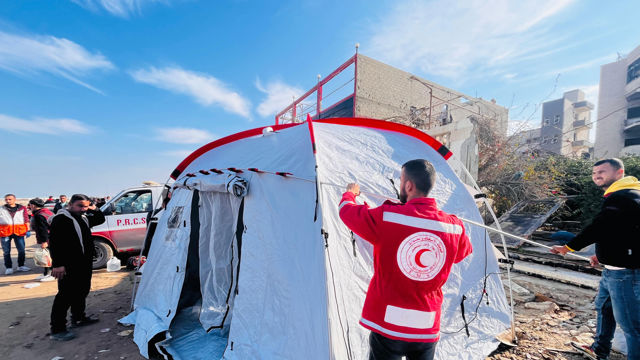
Norwegian assistance to Palestine is divided between long-term development support and humanitarian aid in Gaza and the West Bank.
Norwegian assistance to Palestine is divided between long-term development efforts and humanitarian action in Gaza and the West Bank.
Humanitarian assistance to Palestine includes life-saving action with a strong emphasis on protection. It includes access to basic services and assistance for the civilian population in Gaza and the occupied areas of the West Bank.
Results from 2025
- Since the ceasefire in October 2025, WFP has reached more than 1 million people in Gaza each month with food assistance through 59 distribution points, as well as 250,000 people with digital cash assistance.
- In 2025, almost 81,000 people in Gaza and the West Bank received legal information, counselling and assistance through the Norwegian Refugee Council to improve their access to basic services and rights.
- Since the ceasefire in October 2025, 193,500 children have returned to in-person education in UNRWA collective shelters and in UNICEF-supported temporary learning centres in Gaza. In addition, UNRWA provides distance learning to a further 280,000 children.
- More than 700,000 women and girls gained access to sexual and reproductive health services and information, and more than 1.8 million people received services related to the prevention of and response to sexual and gender-based violence through UNFPA and its local partners.
What does humanitarian assistance to Palestine support?
Norwegian humanitarian assistance protects the civilian population and includes, among other things:
- food and nutrition
- shelter
- cash programmes
- water and sanitation
- health services, including mental health and sexual and reproductive health
- education
- rehabilitation of critical civilian infrastructure
Protection is a central part of Norway’s humanitarian action: protection of children, protection against sexual and gender-based violence, and efforts to reduce the impact of armed conflict, violence and occupation on the civilian population.
Humanitarian partners in Palestine
Norwegian humanitarian assistance is channelled through the UN, including the humanitarian country-based pooled fund in Palestine (oPt HF), the Red Cross and Red Crescent Movement, and Norwegian and other international and local civil society organisations. See overview:
| Organisation |
Totalt 2025, NOK million |
| Strategic partners | 174 |
| Norwegian Red Cross | 70 |
| Norwegian Refugee Council | 46 |
| Norwegian People´s Aid | 19 |
| Save the Children | 17 |
| Norwegian Church Aid | 10 |
| Caritas Norway | 9 |
| NORCAP | 3 |
| United Nations | 654 |
| UNRWA | 235 |
| UNOCHA - OPT Humanitarian Fund | 127 |
| UNICEF | 100 |
| WHO – World Health Organisation | 100 |
| WFP – World Food Programme | 60 |
| UNFPA – United Nations Population Fund | 32 |
| International Red Cross and Red Crescent Movement | 80 |
| ICRC | 80 |
| Other humanitarian organisations | 25 |
| Norwac - Norwegian Aid Committee | 25 |
| Total | 933 |
Humanitarian efforts have supported the United Nations Relief and Works Agency for Palestine Refugees in the Near East (UNRWA) in Palestine, as well as in Jordan, Lebanon and Syria.
UNRWA works across a broad range of humanitarian sectors and has close to 16,000 staff in Palestine.
UNRWA provides around 40 per cent of primary healthcare in Gaza, approximately 30–40 per cent of water distribution, and essential sanitation services.
In Gaza, UNRWA has succeeded in getting nearly 60,000 children back into regular education in temporary facilities and provides distance learning to a further 280,000 children in Gaza, who had been without schooling from autumn 2023 until the ceasefire agreement entered into force in autumn 2025.
Palestine has a strong and active civil society. Locally led humanitarian action is supported through many international partners and through Norwegian support to the humanitarian country-based pooled fund for Palestine (oPt HF), where 52 per cent of a total of USD 67 million went to 19 local partners in 2025, most of it without intermediaries.
Norway was the fund’s fourth-largest donor in 2025. A total of 135 projects received support, mainly in the areas of shelter, water and sanitation, food security, cash assistance programmes and protection. Norway sits on the fund’s advisory board and follows the response closely.
UNICEF is an important partner, particularly in relation to child protection, access to education and cash assistance.
Protection of children, including children without caregivers, children with disabilities, and children with extensive injuries and trauma, is a priority area.
UNICEF also coordinates the education response and helps children resume learning in temporary learning centres – a critical link for providing psychosocial support and mental health support, while also connecting children to services in nutrition, child protection, health, water and sanitation.
Norwegian support to UNICEF also contributes to life-saving child and maternal healthcare, vaccination and treatment of malnutrition. As coordinator for safe access to water, sanitation and hygiene, UNICEF works on rehabilitating water and sewage networks and enabling critical water, sanitation and hygiene services.
Alongside UNICEF, Save the Children is one of Norway’s key partners for child protection.
Save the Children’s teams provide psychosocial support and comprehensive follow-up for children, including children who are alone or separated from their families, children with injuries and disabilities, and child-headed households.
Cash assistance is provided in critical cases and contributes to stronger protection. Within education programmes, temporary learning is offered with a particular emphasis on basic numeracy and literacy, as well as non-formal learning, with increased focus on learning outcomes, alignment with formal curricula and recovery of lost learning.
In Egypt, Save the Children has strengthened its response to meet the immediate needs of children and caregivers who have been medically evacuated from Gaza to Egypt.
The International Committee of the Red Cross (ICRC) has played a central role in relation to the release of hostages/detainees in connection with the ceasefire agreement. It has a particular focus on advocacy for compliance with international humanitarian law in both Palestine and Israel and is therefore one of Norway’s most important partners when it comes to protecting civilians in armed conflict.
In addition to this unique role, the ICRC works across a broad humanitarian spectrum, including protection, health, operation of field hospitals, water, sanitation and hygiene, electricity and other fuel supply.
The Norwegian Red Cross works both with the ICRC and with the Palestine Red Crescent Society (PRCS) in Palestine. Support to the Norwegian Red Cross contributes to PRCS’s life-saving work in emergency assistance and primary healthcare. This support includes ambulance services, health clinics and first aid.
The Norwegian Refugee Council (NRC) plays a central role and contributes across a broad range of humanitarian sectors, including shelter, where NRC coordinates the humanitarian response, as well as cash programmes, water and sanitation services, and education.
NRC’s protection programmes place particular emphasis on legal assistance to protect people against home demolitions, evictions and seizure orders, revocation of residency rights, access restrictions, and settler violence and discrimination in the West Bank.
In addition to this important role, NRC supports communities in preventing and reducing protection risks by promoting inclusive and local governance in shelters for internally displaced people.
Through NORCAP, emergency preparedness and expertise are funded to meet the needs of humanitarian partner organisations in Palestine – particularly within the UN system. NORCAP experts are engaged in strengthening the implementation of life-saving assistance, humanitarian access and civil-military coordination, protection expertise, and coordination and logistics support for partners in Gaza, Egypt and the West Bank. NORCAP provides expertise in line with the priorities of the UN-coordinated humanitarian response plan.
Support to the World Health Organization (WHO) helps ensure access to basic health services, treatment, medicines and medical equipment, in cooperation with, among others, UNRWA and UNICEF. WHO is responsible for the procurement and entry of a large share of medical equipment into Gaza and is also a particularly important partner for Norwac – another key Norwegian health partner in Palestine, which contributes life-saving emergency medical teams to strengthen hospital capacity, medical supplies and equipment, maintenance and rehabilitation of health infrastructure, and capacity-building.
Norwegian People’s Aid works primarily to strengthen local organisations and their humanitarian action in communities through training in civilian protection and conflict preparedness, including risk education on explosives and explosive remnants of war, as well as assistance to women and children who have experienced sexual and gender-based violence. Norwegian People’s Aid also supports emergency relief projects in food security and cash programmes, and local projects that help strengthen livelihoods and create opportunities for income and work.
The World Food Programme (WFP) coordinates food security efforts, to which several Norwegian partners contribute. WFP maintains life-saving food assistance through multiple distribution points and supports the operation and rehabilitation of bakeries and soup kitchens. Beyond food security and nutrition, WFP is an important actor in cash assistance, telecommunications and logistics in Gaza. WFP’s common logistics services ensure the transport and storage of food and other items on behalf of a large number of humanitarian actors in Gaza.
The United Nations Population Fund (UNFPA) has played a crucial role in preventing and protecting survivors of sexual and gender-based violence, safeguarding sexual and reproductive health, and supporting young people in Gaza and the West Bank.
Norwegian Church Aid is an important partner for Norway, contributing to protection from violence and abuse in close cooperation with several local partners in Gaza and the West Bank. Its efforts include psychosocial support, legal assistance and safe spaces for survivors of violence and abuse, as well as cash programmes to help improve protection and resilience.
Norwegian Church Aid also helps increase access to water, sanitation and hygiene, including by installing mobile latrines for displaced families who lack access to sanitation services and distributing clean drinking water in order to maintain safe drinking water standards and protect against health risks.
Through Caritas Norway, cash programmes are supported to strengthen the resilience of vulnerable families. Caritas also contributes to primary healthcare, maternal and child health services, and treatment of communicable and non-communicable diseases. Medical teams provide treatment for chronic illnesses, targeted health services for older people, antenatal care and other specialist services, with a particular focus on mental health and psychosocial services for children and their caregivers.