The sustainability goals
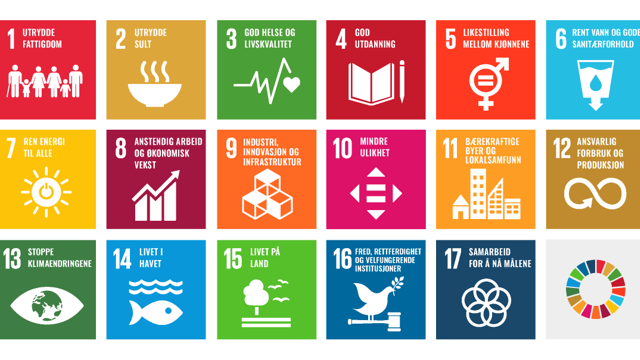
The UN's 17 sustainability goals will guide Norwegian development policy until 2030.
Extreme poverty must be eradicated. Social inequalities must be equalised. Climate change must be slowed down.
The UN's member states have adopted 17 common global goals for sustainable development over the next 15 years.
The new sustainability goals see environment, economy and social development in context.
Replaces the Millennium Development Goals
The sustainability goals replace the Millennium Development Goals that were adopted in 2000.
The Millennium Development Goals have been a success. They have mobilized for joint efforts against poverty and for development.
Extreme poverty has been halved. Nine out of ten children now go to school. Millions of malaria and HIV/AIDS-related deaths have been averted.
Several of the Millennium Development Goals have been continued in the sustainability goals.
New development features
The breadth of sustainability goals reflects the changes the world community has undergone since 2000.
It will be important to strengthen public institutions, good governance and stability. These are fundamental structures for poverty reduction and sustainable development, especially in vulnerable communities.
Applies to all countries
The goals are not just a plan for the developing countries. They are based on domestic political conditions in all countries.
The new agenda is clear about the framework conditions that must be the basis for this work to be successful.
It points out that democracy, good governance and a legal culture are essential for sustainable development. The goals aim to realize human rights for all.
The message is that no one should be left behind: No one will be left behind.
Democratic process
All of the UN's 193 countries have been allowed to participate in the design of the sustainability goals.
The Millennium Development Goals were drawn up by employees of the UN system, based on already agreed commitments. In contrast, the sustainability goals have come about through intergovernmental negotiations.
Civil society organizations and private business have also contributed.
Climate focus
Through the new agenda, the world has set itself the goal of taking climate and environmental considerations into account. This includes industry, agriculture, cities and energy.
During the COP21 climate summit in Paris in 2015, all the world's countries agreed to keep the global temperature increase well below 2 degrees compared to pre-industrial levels, and strive to keep the temperature increase below 1.5 degrees.